 Add to Chrome
 Add to Firefox
 Add to Edge
Plug-and-play Class-aware Knowledge Injection for Prompt Learning with Visual-Language Model
May 07, 2026
Prompt learning has become an effective and widely used technique in enhancing vision-language models (VLMs) such as CLIP for various downstream tasks, particularly in zero-shot classification within specific domains. Existing methods typically focus on either learning class-shared prompts for a given domain or generating instance-specific prompts through conditional prompt learning. While these methods have achieved promising performance, they often overlook class-specific knowledge in prompt design, leading to suboptimal outcomes. The underlying reasons are: 1) class-specific prompts offer more fine-grained supervision compared to coarse class-shared prompts, which helps prevent misclassification of data from different classes into a single class; 2) compared to class-specific prompts, instance-specific prompts neglect the richer class-level information across multiple instances, potentially causing data from the same class to be divided into multiple classes. To effectively supplement the class-specific knowledge into existing methods, we propose a plug-and-play Class-Aware Knowledge Injection (CAKI) framework. CAKI comprises two key components, i.e., class-specific prompt generation and query-key prompt matching. The former encodes class-specific knowledge into prompts from few-shot samples that belong to the same class and stores the learned prompts in a class-level knowledge bank. The latter provides a plug-and-play mechanism for each test instance to retrieve relevant class-level knowledge from the knowledge bank and inject such knowledge to refine model predictions. Extensive experiments demonstrate that our CAKI effectively improves the performance of existing methods on base and novel classes. Code is publicly available at \href{https://github.com/yjh576/CAKI}{this https URL}.

Generalizable Knowledge Distillation from Vision Foundation Models for Semantic Segmentation
Mar 03, 2026Knowledge distillation (KD) has been widely applied in semantic segmentation to compress large models, but conventional approaches primarily preserve in-domain accuracy while neglecting out-of-domain generalization, which is essential under distribution shifts. This limitation becomes more severe with the emergence of vision foundation models (VFMs): although VFMs exhibit strong robustness on unseen data, distilling them with conventional KD often compromises this ability. We propose Generalizable Knowledge Distillation (GKD), a multi-stage framework that explicitly enhances generalization. GKD decouples representation learning from task learning. In the first stage, the student acquires domain-agnostic representations through selective feature distillation, and in the second stage, these representations are frozen for task adaptation, thereby mitigating overfitting to visible domains. To further support transfer, we introduce a query-based soft distillation mechanism, where student features act as queries to teacher representations to selectively retrieve transferable spatial knowledge from VFMs. Extensive experiments on five domain generalization benchmarks demonstrate that GKD consistently outperforms existing KD methods, achieving average gains of +1.9% in foundation-to-foundation (F2F) and +10.6% in foundation-to-local (F2L) distillation. The code will be available at https://github.com/Younger-hua/GKD.
OmniVL-Guard: Towards Unified Vision-Language Forgery Detection and Grounding via Balanced RL
Feb 12, 2026Existing forgery detection methods are often limited to uni-modal or bi-modal settings, failing to handle the interleaved text, images, and videos prevalent in real-world misinformation. To bridge this gap, this paper targets to develop a unified framework for omnibus vision-language forgery detection and grounding. In this unified setting, the {interplay} between diverse modalities and the dual requirements of simultaneous detection and localization pose a critical ``difficulty bias`` problem: the simpler veracity classification task tends to dominate the gradients, leading to suboptimal performance in fine-grained grounding during multi-task optimization. To address this challenge, we propose \textbf{OmniVL-Guard}, a balanced reinforcement learning framework for omnibus vision-language forgery detection and grounding. Particularly, OmniVL-Guard comprises two core designs: Self-Evolving CoT Generatio and Adaptive Reward Scaling Policy Optimization (ARSPO). {Self-Evolving CoT Generation} synthesizes high-quality reasoning paths, effectively overcoming the cold-start challenge. Building upon this, {Adaptive Reward Scaling Policy Optimization (ARSPO)} dynamically modulates reward scales and task weights, ensuring a balanced joint optimization. Extensive experiments demonstrate that OmniVL-Guard significantly outperforms state-of-the-art methods and exhibits zero-shot robust generalization across out-of-domain scenarios.
Multi-Scale Global-Instance Prompt Tuning for Continual Test-time Adaptation in Medical Image Segmentation
Feb 05, 2026Distribution shift is a common challenge in medical images obtained from different clinical centers, significantly hindering the deployment of pre-trained semantic segmentation models in real-world applications across multiple domains. Continual Test-Time Adaptation(CTTA) has emerged as a promising approach to address cross-domain shifts during continually evolving target domains. Most existing CTTA methods rely on incrementally updating model parameters, which inevitably suffer from error accumulation and catastrophic forgetting, especially in long-term adaptation. Recent prompt-tuning-based works have shown potential to mitigate the two issues above by updating only visual prompts. While these approaches have demonstrated promising performance, several limitations remain:1)lacking multi-scale prompt diversity, 2)inadequate incorporation of instance-specific knowledge, and 3)risk of privacy leakage. To overcome these limitations, we propose Multi-scale Global-Instance Prompt Tuning(MGIPT), to enhance scale diversity of prompts and capture both global- and instance-level knowledge for robust CTTA. Specifically, MGIPT consists of an Adaptive-scale Instance Prompt(AIP) and a Multi-scale Global-level Prompt(MGP). AIP dynamically learns lightweight and instance-specific prompts to mitigate error accumulation with adaptive optimal-scale selection mechanism. MGP captures domain-level knowledge across different scales to ensure robust adaptation with anti-forgetting capabilities. These complementary components are combined through a weighted ensemble approach, enabling effective dual-level adaptation that integrates both global and local information. Extensive experiments on medical image segmentation benchmarks demonstrate that our MGIPT outperforms state-of-the-art methods, achieving robust adaptation across continually changing target domains.
In defense of the two-stage framework for open-set domain adaptive semantic segmentation
Jan 04, 2026Open-Set Domain Adaptation for Semantic Segmentation (OSDA-SS) presents a significant challenge, as it requires both domain adaptation for known classes and the distinction of unknowns. Existing methods attempt to address both tasks within a single unified stage. We question this design, as the annotation imbalance between known and unknown classes often leads to negative transfer of known classes and underfitting for unknowns. To overcome these issues, we propose SATS, a Separating-then-Adapting Training Strategy, which addresses OSDA-SS through two sequential steps: known/unknown separation and unknown-aware domain adaptation. By providing the model with more accurate and well-aligned unknown classes, our method ensures a balanced learning of discriminative features for both known and unknown classes, steering the model toward discovering truly unknown objects. Additionally, we present hard unknown exploration, an innovative data augmentation method that exposes the model to more challenging unknowns, strengthening its ability to capture more comprehensive understanding of target unknowns. We evaluate our method on public OSDA-SS benchmarks. Experimental results demonstrate that our method achieves a substantial advancement, with a +3.85% H-Score improvement for GTA5-to-Cityscapes and +18.64% for SYNTHIA-to-Cityscapes, outperforming previous state-of-the-art methods.
Open-World Deepfake Attribution via Confidence-Aware Asymmetric Learning
Dec 14, 2025The proliferation of synthetic facial imagery has intensified the need for robust Open-World DeepFake Attribution (OW-DFA), which aims to attribute both known and unknown forgeries using labeled data for known types and unlabeled data containing a mixture of known and novel types. However, existing OW-DFA methods face two critical limitations: 1) A confidence skew that leads to unreliable pseudo-labels for novel forgeries, resulting in biased training. 2) An unrealistic assumption that the number of unknown forgery types is known *a priori*. To address these challenges, we propose a Confidence-Aware Asymmetric Learning (CAL) framework, which adaptively balances model confidence across known and novel forgery types. CAL mainly consists of two components: Confidence-Aware Consistency Regularization (CCR) and Asymmetric Confidence Reinforcement (ACR). CCR mitigates pseudo-label bias by dynamically scaling sample losses based on normalized confidence, gradually shifting the training focus from high- to low-confidence samples. ACR complements this by separately calibrating confidence for known and novel classes through selective learning on high-confidence samples, guided by their confidence gap. Together, CCR and ACR form a mutually reinforcing loop that significantly improves the model's OW-DFA performance. Moreover, we introduce a Dynamic Prototype Pruning (DPP) strategy that automatically estimates the number of novel forgery types in a coarse-to-fine manner, removing the need for unrealistic prior assumptions and enhancing the scalability of our methods to real-world OW-DFA scenarios. Extensive experiments on the standard OW-DFA benchmark and a newly extended benchmark incorporating advanced manipulations demonstrate that CAL consistently outperforms previous methods, achieving new state-of-the-art performance on both known and novel forgery attribution.
TDEdit: A Unified Diffusion Framework for Text-Drag Guided Image Manipulation
Sep 26, 2025This paper explores image editing under the joint control of text and drag interactions. While recent advances in text-driven and drag-driven editing have achieved remarkable progress, they suffer from complementary limitations: text-driven methods excel in texture manipulation but lack precise spatial control, whereas drag-driven approaches primarily modify shape and structure without fine-grained texture guidance. To address these limitations, we propose a unified diffusion-based framework for joint drag-text image editing, integrating the strengths of both paradigms. Our framework introduces two key innovations: (1) Point-Cloud Deterministic Drag, which enhances latent-space layout control through 3D feature mapping, and (2) Drag-Text Guided Denoising, dynamically balancing the influence of drag and text conditions during denoising. Notably, our model supports flexible editing modes - operating with text-only, drag-only, or combined conditions - while maintaining strong performance in each setting. Extensive quantitative and qualitative experiments demonstrate that our method not only achieves high-fidelity joint editing but also matches or surpasses the performance of specialized text-only or drag-only approaches, establishing a versatile and generalizable solution for controllable image manipulation. Code will be made publicly available to reproduce all results presented in this work.
Beyond Artificial Misalignment: Detecting and Grounding Semantic-Coordinated Multimodal Manipulations
Sep 16, 2025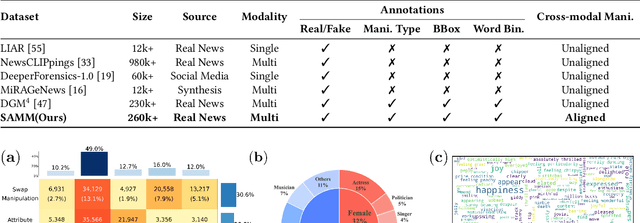
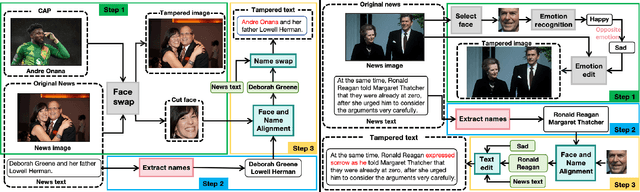
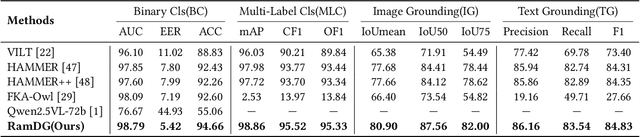
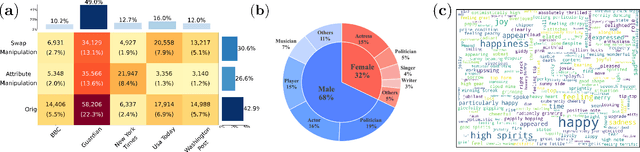
The detection and grounding of manipulated content in multimodal data has emerged as a critical challenge in media forensics. While existing benchmarks demonstrate technical progress, they suffer from misalignment artifacts that poorly reflect real-world manipulation patterns: practical attacks typically maintain semantic consistency across modalities, whereas current datasets artificially disrupt cross-modal alignment, creating easily detectable anomalies. To bridge this gap, we pioneer the detection of semantically-coordinated manipulations where visual edits are systematically paired with semantically consistent textual descriptions. Our approach begins with constructing the first Semantic-Aligned Multimodal Manipulation (SAMM) dataset, generated through a two-stage pipeline: 1) applying state-of-the-art image manipulations, followed by 2) generation of contextually-plausible textual narratives that reinforce the visual deception. Building on this foundation, we propose a Retrieval-Augmented Manipulation Detection and Grounding (RamDG) framework. RamDG commences by harnessing external knowledge repositories to retrieve contextual evidence, which serves as the auxiliary texts and encoded together with the inputs through our image forgery grounding and deep manipulation detection modules to trace all manipulations. Extensive experiments demonstrate our framework significantly outperforms existing methods, achieving 2.06\% higher detection accuracy on SAMM compared to state-of-the-art approaches. The dataset and code are publicly available at https://github.com/shen8424/SAMM-RamDG-CAP.
Towards Fine-Grained Emotion Understanding via Skeleton-Based Micro-Gesture Recognition
Jun 15, 2025We present our solution to the MiGA Challenge at IJCAI 2025, which aims to recognize micro-gestures (MGs) from skeleton sequences for the purpose of hidden emotion understanding. MGs are characterized by their subtlety, short duration, and low motion amplitude, making them particularly challenging to model and classify. We adopt PoseC3D as the baseline framework and introduce three key enhancements: (1) a topology-aware skeleton representation specifically designed for the iMiGUE dataset to better capture fine-grained motion patterns; (2) an improved temporal processing strategy that facilitates smoother and more temporally consistent motion modeling; and (3) the incorporation of semantic label embeddings as auxiliary supervision to improve the model generalization. Our method achieves a Top-1 accuracy of 67.01\% on the iMiGUE test set. As a result of these contributions, our approach ranks third on the official MiGA Challenge leaderboard. The source code is available at \href{https://github.com/EGO-False-Sleep/Miga25_track1}{https://github.com/EGO-False-Sleep/Miga25\_track1}.
Towards Micro-Action Recognition with Limited Annotations: An Asynchronous Pseudo Labeling and Training Approach
Apr 10, 2025Micro-Action Recognition (MAR) aims to classify subtle human actions in video. However, annotating MAR datasets is particularly challenging due to the subtlety of actions. To this end, we introduce the setting of Semi-Supervised MAR (SSMAR), where only a part of samples are labeled. We first evaluate traditional Semi-Supervised Learning (SSL) methods to SSMAR and find that these methods tend to overfit on inaccurate pseudo-labels, leading to error accumulation and degraded performance. This issue primarily arises from the common practice of directly using the predictions of classifier as pseudo-labels to train the model. To solve this issue, we propose a novel framework, called Asynchronous Pseudo Labeling and Training (APLT), which explicitly separates the pseudo-labeling process from model training. Specifically, we introduce a semi-supervised clustering method during the offline pseudo-labeling phase to generate more accurate pseudo-labels. Moreover, a self-adaptive thresholding strategy is proposed to dynamically filter noisy labels of different classes. We then build a memory-based prototype classifier based on the filtered pseudo-labels, which is fixed and used to guide the subsequent model training phase. By alternating the two pseudo-labeling and model training phases in an asynchronous manner, the model can not only be learned with more accurate pseudo-labels but also avoid the overfitting issue. Experiments on three MAR datasets show that our APLT largely outperforms state-of-the-art SSL methods. For instance, APLT improves accuracy by 14.5\% over FixMatch on the MA-12 dataset when using only 50\% labeled data. Code will be publicly available.